A new species documented in the Parks of the Cottian Alps by Luca Anselmo
Aug. 5, 2026 Research

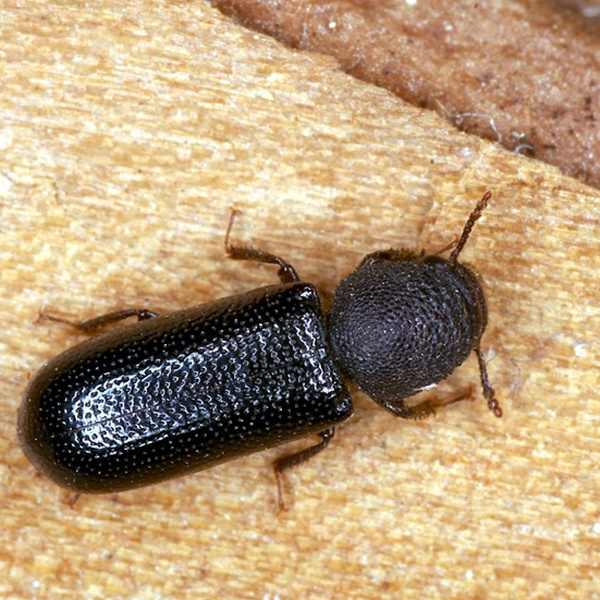
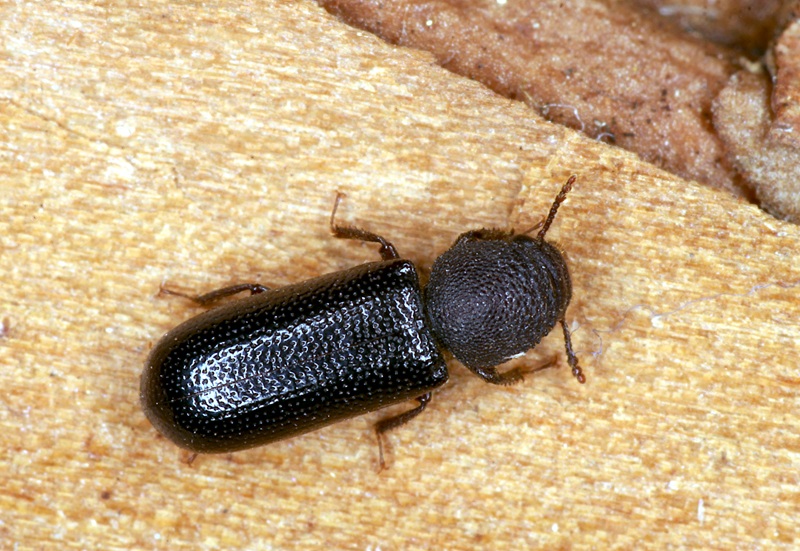
A specimen of Stephanopachys linearis
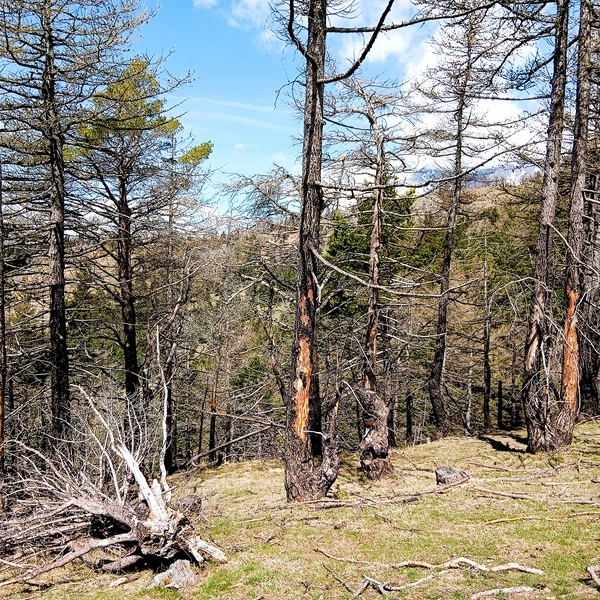
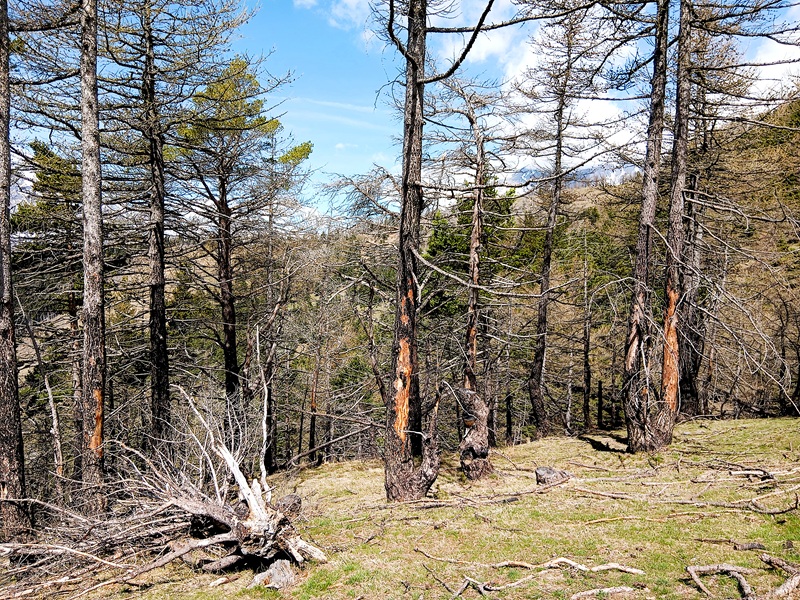
The typical habitat of Stephanopachys linearis
A specimen of Stephanopachys linearis - L. Anselmo
The typical habitat of Stephanopachys linearis - L. Anselmo
The news is impactful on public opinion: in the Protected Areas of the Cottian Alps, a species that was virtually unknown in Italy has been found, the first and last sighting of which dates back to 90 years ago. It was published on July 31, 2026, in the scientific journal Biogeographia – The Journal of Integrative Biogeography thanks to the research conducted by biologist Luca Anselmo, a doctoral student in the Department of Life Sciences and System Biology at the University of Turin under the scientific supervision of Simona Bonelli and Enrico Caprio as co-tutors.
The species in question is Stephanopachys linearis, a tiny saproxylic insect – about half a centimeter long – that lives in wooded environments, of which some finds have been made in the site of the Natura 2000 network “Rocciamelone”. It belongs to the order of beetles, family of bostrichids, and is under protection in the European Union as per the Habitat Directive, which has included it in Annex II as a protected species requiring the designation of special conservation areas.
“The S. linearis – tells us Luca Anselmo, a historical scientific collaborator of the Protected Areas of the Cottian Alps – has the particularity of being strongly pyrophilic, that is, it chooses partially fire-damaged trees as its preferred habitat. Its distribution is typically boreal-alpine: in Europe, it is mainly found in the Scandinavian countries where the frequency of spontaneous fires is also higher, while in the alpine context it is effectively a glacial relict, having migrated south during glaciations and then remaining in high-altitude areas where it finds climatic conditions similar to those of the north. In the Val di Susa, it appeared in those areas on the fringes of the great fires of 2017 between the bark and the trunk of larches and Scots pines partially affected by the flames but still alive.”
It is easy to understand that the scarcity of environments in which the species survives makes it extremely rare in the Alps. In Italy, 3 specimens had been recorded in Tolmezzo, Friuli Venezia Giulia, in 1937 before the rediscovery by Luca Anselmo in spring 2026. Other historical observations were made in Austria where the species was declared extinct, while more recent sightings have been recorded in the French region of Queyras.
“I set out in 2021 – Anselmo continues – following the traces of Stephanopachys substriatus which I then identified, in Italy for the first time after 25 years, first in high Val di Susa, in the Natura 2000 site “Cima Fournier e Lago Nero” and then in other areas of Piedmont and Aosta Valley. This insect is less specific because it also lives in the trunks of trees damaged by lightning strikes or landslides, not just from fire. But, clearly, the challenge that S. linearis offered me was irresistible. And just when I was about to give up, the first tiny specimen appeared before my eyes.”
The theme of Anselmo's PhD concerns the conservation strategies for those rarer species for which only limited data is available. As in the case we are discussing, the Italian institutions will need to study monitoring and protection strategies moving forward.
“Through the University of Turin – Anselmo concludes – we have submitted documentation to ISPRA, Piedmont Region, and the Protected Areas of the Cottian Alps so that more in-depth studies can be initiated as soon as possible. For my part, I am engaged in reprocessing the collected data to better understand the habits and distribution of the species. But beyond the practical implications of this discovery, the most fascinating aspect is linked to the extraordinary variety and complexity of the biodiversity we possess in the alpine territory where, in extremely limited spaces, species that require profoundly different ecological conditions coexist. Paradoxically, even in the Alps, where natural wildfire phenomena are rather rare, certain pyrophilic species have managed to survive in a context where fire generally has profoundly negative consequences for overall biodiversity. The conservation challenge must necessarily take into account this exceptional diversity further threatened by the effects of the climate crisis that are increasingly decisively intervening.”
Attachments:
| open_in_new The scientific article | The scientific article published by Luca Anselmo. | 3.9 MB |
You might also be interested in...
- campaign Climate change is pushing birds higher.
- campaign Tick Project: monitoring activities year 2025
- campaign The project of the Alpi Cozie Parks on iNaturalist surpasses 100 thousand.
- campaign The results of the Gloria project published in the journal "Science"
- tactic Alcotra BiodivTourAlps
- tactic BIODIV'CONNECT
- tactic PITEM Biodiv’Alp: COBIODIV
- tactic The Protected Areas of the Cozie Alps project on iNaturalist
- tactic Pitem Biodiv'Alp
- tactic Monitoraggio della Biodiversità Animale in Ambiente Alpino