The results of the Gloria project published in the journal "Science"
Sept. 24, 2026 Research

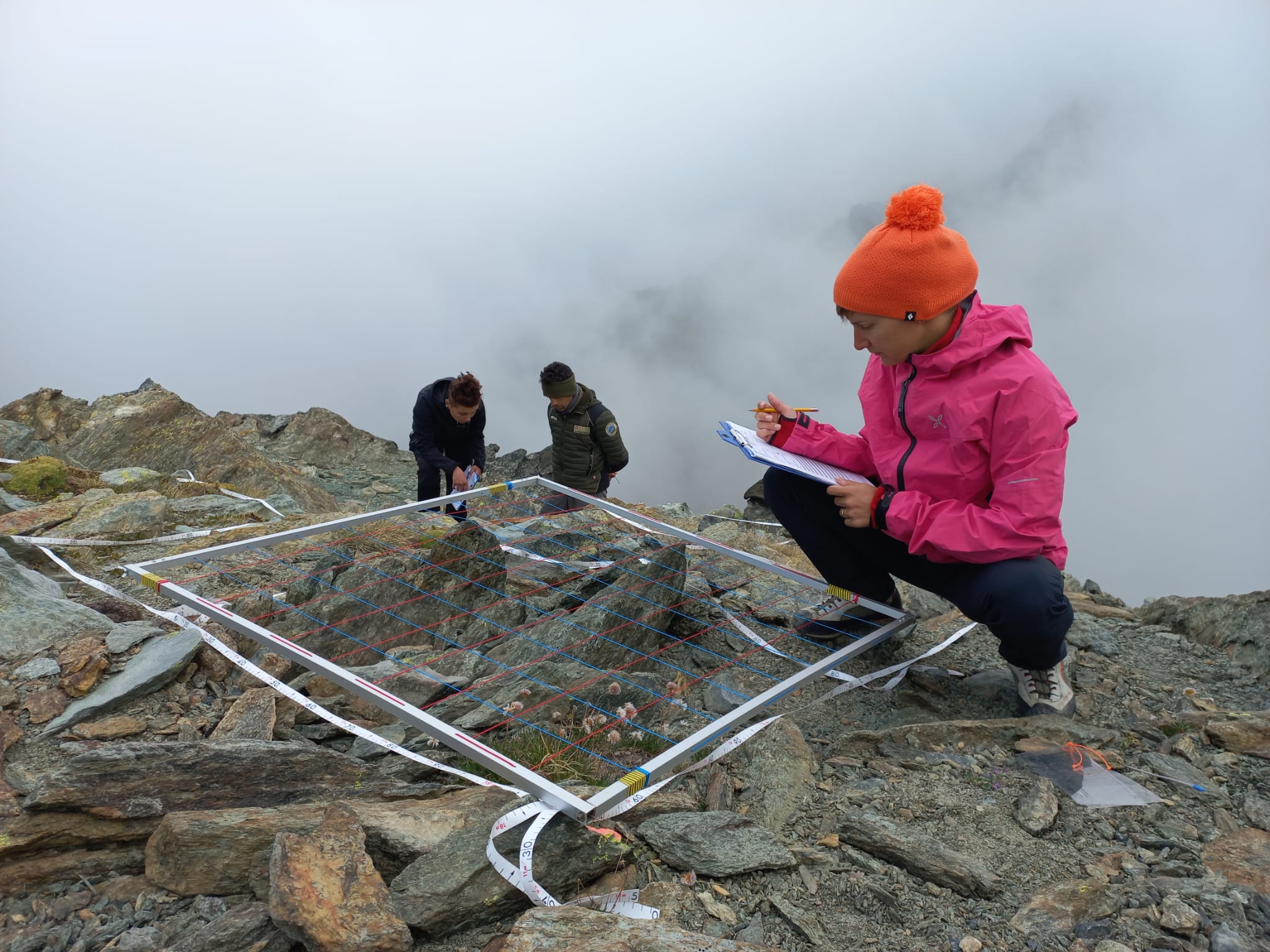
An image of the surveys conducted as part of the Gloria Project.
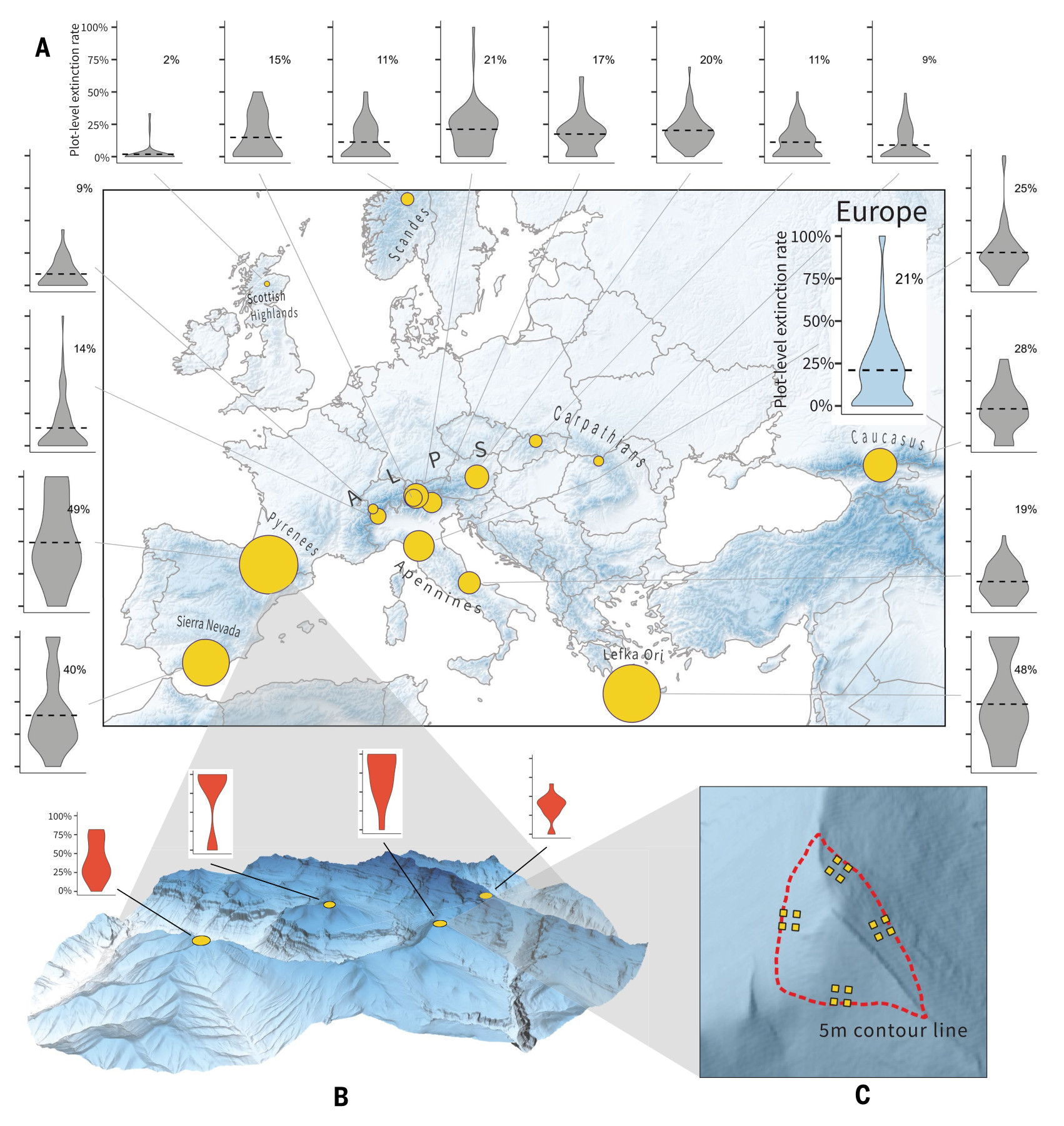
In the image from the article published in "Science," figure A shows the distribution of the sampled sites. The sizes of the circles indicate the average proportion of local extinctions from 2001 to 2022 across all plots in a given mountain region. The violin plots display the distribution of extinction rates at the plot level. In figures B and C, the distribution of sites in each mountain region can be observed.
An image of the surveys conducted as part of the Gloria Project. - Arch. Parchi Alpi Cozie
In the image from the article published in "Science," figure A shows the distribution of the sampled sites. The sizes of the circles indicate the average proportion of local extinctions from 2001 to 2022 across all plots in a given mountain region. The violin plots display the distribution of extinction rates at the plot level. In figures B and C, the distribution of sites in each mountain region can be observed.
The results of the researches conducted within the international GLORIA project have received prestigious recognition with the publication in the scientific journal “Science”, one of the most authoritative worldwide. The study also involved the Protected Areas of the Cottian Alps with park rangers Debora Barolin – one of the authors of the paper – and Guido Teppa, who collaborated on the survey campaigns conducted in Valle d’Aosta in 2017 and 2022, for which a report has been published on this website, available at the following link.
A European snapshot of local extinctions
The GLORIA project (GLobal Observation Research Initiative in Alpine environments), signed by agroup of international researchers coordinated by the University of Vienna, analyzed data collected from 896 permanent plots, distributed across 62 peaks in 16 European mountain regions, from the Pyrenees to the Caucasus, monitored four times between 2001 and 2022 at seven-year intervals. The objective was to understand what lies behind an apparently positive phenomenon, the increase in plant species richness observed in recent decades on alpine peaks, already noted in the previous article regarding the Aosta Valley data.
The results confirm and deepen, on a continental scale, what has emerged at the local level: the floristic enrichment masks other dynamics. The authors actually reported a significant increase in the rate of local extinctions, meaning the disappearance of species recorded in one survey and not found in subsequent ones in the same plot. This rate has increased over time at all levels of analysis (plot, peak, region) and has been found to be higher the more pronounced the warming recorded in the 14 preceding years: for every 0.1°C rise in temperature, the proportion of local extinctions grows from 1 to 1.6% (depending on whether the plot, peak, or region was analyzed).
Another relevant finding concerns the relationship between the decline in coverage of a species and its subsequent disappearance: a decrease in the abundance of a species in previous surveys has been confirmed as an early warning signal, useful for identifying the most at-risk species before local extinction occurs. The most exposed species have been found to be those located towards the lower margin, and warmer, of their altitudinal range, and those present in plant communities subject to a more pronounced “thermophilization,” meaning the progressive enrichment in species that prefer warmer climatic conditions.
The significance for alpine research
The study suggests that the typical species of higher altitudes, those that are most specialized and often unique from an evolutionary perspective, are also the most vulnerable: lacking a higher altitudinal margin to move to, they cannot compensate for the loss of ground at the lower margins of their range with a similar expansion upwards. The work therefore confirms, with a solid and continental data basis, the hypothesis already put forward at the local level following the Aosta Valley campaign of 2022: behind the apparent enrichment of alpine biodiversity lies a silent and progressive loss of the most characteristic species of high-altitude environments.
The publication in “Science” confirms the scientific value of a monitoring network, that of GLORIA, which relies on the patient work of field surveys conducted by researchers and staff from protected areas across Europe. Even the contribution of the Protected Areas of the Cottian Alps, although developed outside its administrative boundaries, is part of this long-term knowledge path, which will continue to provide valuable data to understand and address the effects of climate change on mountain ecosystems.
The full article published in “Science” is available here.
You might also be interested in...
- campaign Monitorare gli ortotteri: una sperimentazione nei Parchi Alpi Cozie
- campaign The territorial distribution of mustelids in a study
- campaign The project of the Alpi Cozie Parks on iNaturalist surpasses 100 thousand.
- campaign A new species documented in the Parks of the Cottian Alps by Luca Anselmo
- tactic Alcotra BiodivTourAlps
- tactic BIODIV'CONNECT
- tactic PITEM Biodiv’Alp: COBIODIV
- tactic The Protected Areas of the Cozie Alps project on iNaturalist
- tactic Pitem Biodiv'Alp
- tactic Monitoraggio della Biodiversità Animale in Ambiente Alpino