New balances between predators and prey in a research study
July 28, 2026 Research

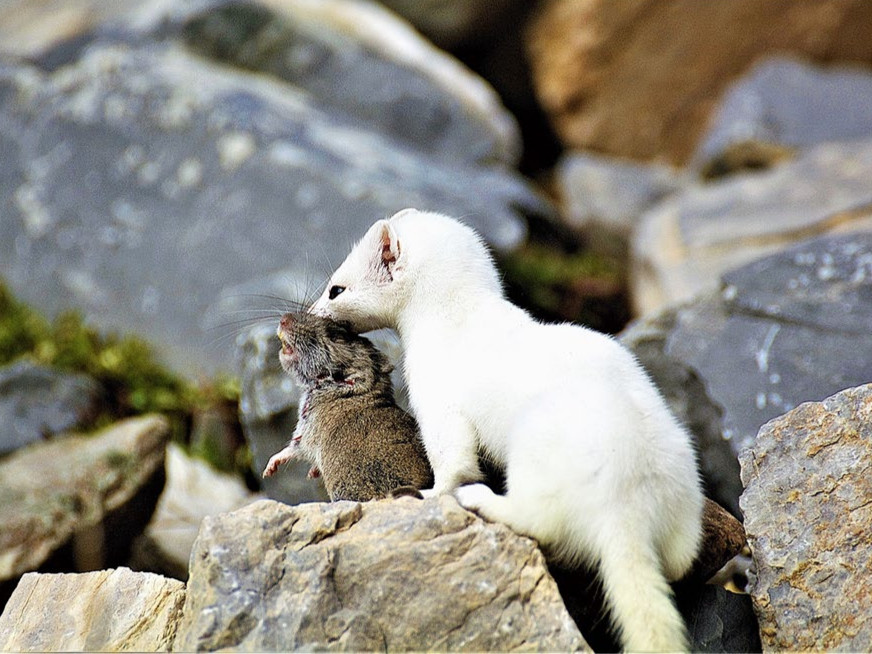
A stoat in its winter coat has just preyed on a snow vole.
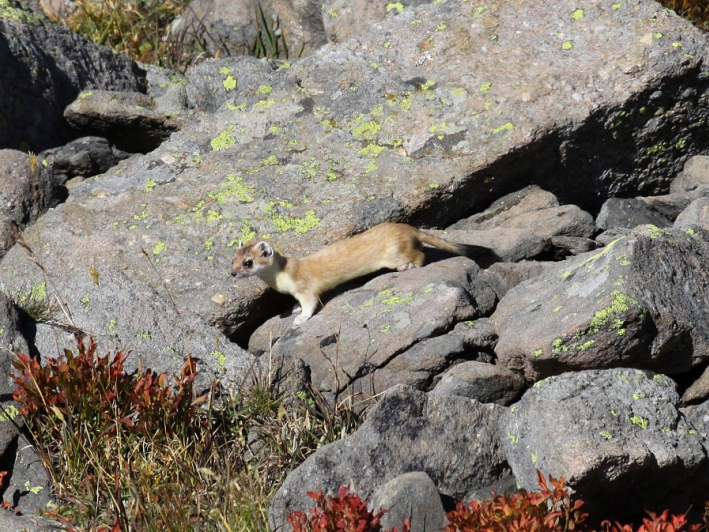
An erminette in the process of molting.
A stoat in its winter coat has just preyed on a snow vole. - E. Pelazza (Aree Protette delle Alpi Marittime)
An erminette in the process of molting. - M. Rosso
Climate change not only alters the distribution of individual species but can also change the relationships that, for thousands of years, have linked predators and prey in alpine ecosystems. This is the main conclusion of the scientific article published in the journal Mammal Research (click here for the full article) published by researchers Marco Granata and Margherita Cattaneo from the University of Turin in collaboration with Gran Paradiso National Park, MUSE – Museum of Sciences of Trento, the Protected Areas of Maritime Alps, the Protected Areas of the Cozie Alps, and the University of Molise.
The research represents one of the most comprehensive studies conducted so far on the ermine (Mustela erminea) in the Italian Alps and stands out for its innovative approach: instead of exclusively analyzing the predator, it also considers the distribution of its main prey, the snow vole (Chionomys nivalis), highlighting how climate changes can modify the entire ecological balance. To build the predictive models, researchers collected over 900 reports of ermine and more than 200 snow vole observations from managing bodies, including the Parks of the Cozie Alps, museums, naturalistic databases, field monitoring activities, and contributions from citizen science.
The ermine is a species highly adapted to cold environments. During winter, its fur turns completely white, allowing it to blend in with the snow both to escape from predators and to hunt more effectively. The research confirms that the duration of snow cover is the primary factor determining the presence of the species: the progressive reduction of snow cover makes the white fur increasingly less effective, raises the risk of predation, and also alters the conditions under which the ermine searches for food during winter.
However, the most interesting aspect of the study is the interaction of the ermine with the snow vole, a rodent closely associated with rocky areas and open high-altitude environments that constitutes its main prey. This is a link that could be radically altered by climate change and the simulations of average temperature increases projected by the year 2100, creating a substantial misalignment. While it is expected that the ermine could lose up to about 36% of its range in the Italian Alps, progressively moving to higher altitudes in search of favorable climatic conditions, the snow vole, on the other hand, could expand into various sectors of the mountain chain and tend, on average, to occupy slightly lower altitudes than the current ones.
According to this model, the ermines will lose their primary food source, while the voles would experience a reduction in the regulatory action of their main predator simply because they will share increasingly smaller portions of habitat, altering an ecological relationship built over the course of evolution. According to the authors, this is one of the most significant possible consequences of climate change on alpine ecosystems, as already noted in the literature for other species.
Finally, the research highlights how biodiversity conservation can no longer be limited to the conservation of individual species, but must also consider the ecological relationships that connect them. In this context, the ermine, due to its close dependence on snow and strong link to a highly specialized prey, confirms itself as a valuable sentinel species of the effects of climate change on high-altitude ecosystems, providing valuable insights for the management and conservation of alpine mountains.
You might also be interested in...
- campaign Climate change is pushing birds higher.
- campaign The territorial distribution of mustelids in a study
- tactic Alcotra AClimo
- campaign The migrations of ibexes and climate change
- campaign Monitorare gli ortotteri: una sperimentazione nei Parchi Alpi Cozie
- campaign The Anthocharis euphenoides beyond yellow
- campaign Tick Project: monitoring activities year 2025
- campaign Il 5x1000 per la Ricerca Scientifica sulle zecche
- campaign Balthazar: storia di un gipeto
- campaign The research days: a report