Lanza's Salamander
An elusive amphibian endemic to the Cottian Alps

 Fauna
Fauna

Classification:
Classification:
Common name: Lanza's salamander
Kingdom: Animalia
Phylum: Chordata
Class: Amphibia
Order: Caudata (or Urodela)
Family: Salamandridae
Genus: Salamandra
Scientific name: Salamandra lanzai (Nascetti, Andreone, Capula & Bullini, 1988)
Habitat:
Endemic species of the Cottian Alps. Lives between 1200 and 2600 meters above sea level
Where can you find me?
Where can you find me?
Parco naturale Orsiera Rocciavrè
ZSC – ZPS Orsiera Rocciavrè
ZSC – ZPS Val Troncea
Classification:
Classification:
Common name: Lanza's salamander
Kingdom: Animalia
Phylum: Chordata
Class: Amphibia
Order: Caudata (or Urodela)
Family: Salamandridae
Genus: Salamandra
Scientific name: Salamandra lanzai (Nascetti, Andreone, Capula & Bullini, 1988)
Habitat:
Endemic species of the Cottian Alps. Lives between 1200 and 2600 meters above sea level
Distribution
The Lanza Salamander is a rare amphibian endemic to the Cottian Alps, found only in a few valleys between Italy and France: Po Valley, Val Pellice, Val Chisone, Val Germanasca, and Val Sangone, as well as in small areas of the Queyras Natural Park in France, in the Ristolas-Mont Viso reserve established specifically to protect the species.
Morphology
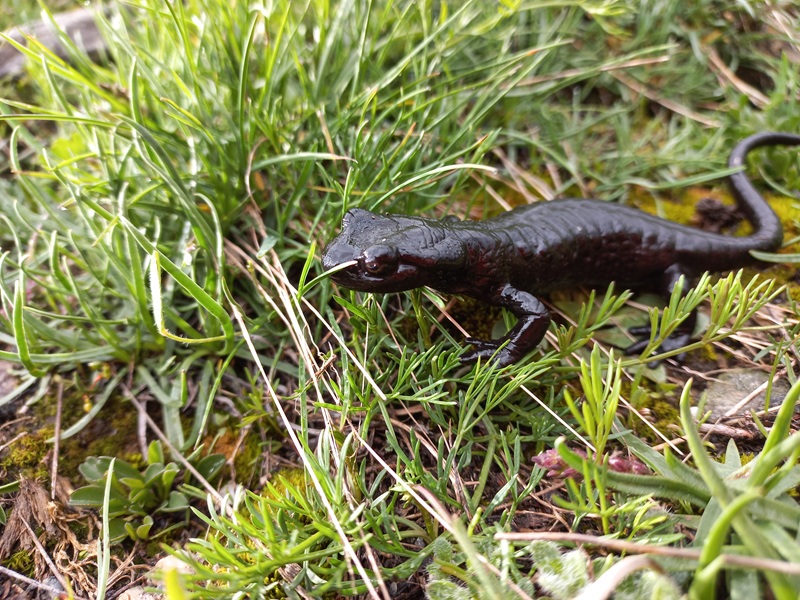
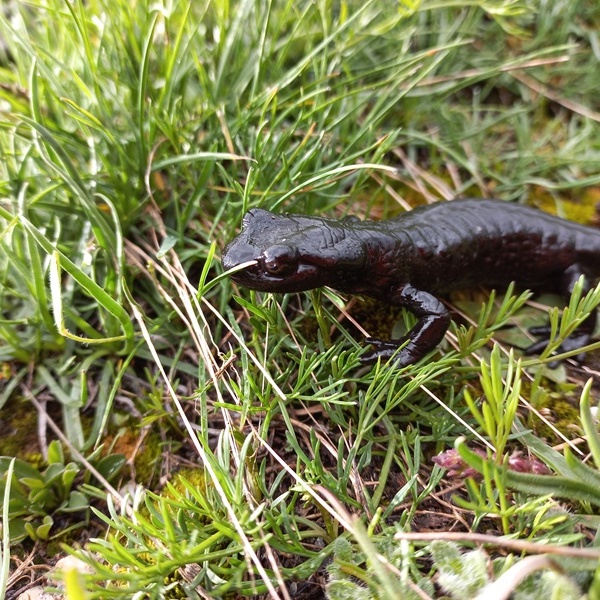
It has a black and shiny color and is characterized by a robust body, a large and flattened head, a tail with a rounded tip, and large parotoid glands on the sides of the head that secrete a repellent and irritating liquid as a defense against predators. It weighs about 20 grams, with an average length of 9 cm.
Habitat and Ecology
In the managed territory of the Cottian Alps Parks Authority, populations of this species live in alpine meadows above the tree line, near small streams, with an abundance of rocks and underground shelters. Much of its life is indeed subterranean: during periods of drought or winter hibernation, it takes refuge underground. It can be encountered more frequently from May to August, during dusk or nighttime, although it can also be seen during the day on rainy or particularly humid days.
Biology
Unlike other amphibians, this species is not tied to water for reproduction. As an adaptation to the harsh temperatures at high altitudes and the short alpine summer, its eggs do not develop in water but within the mother's body, where they take three years to undergo complete metamorphosis. It is therefore referred to as a viviparous species, as it gives birth to fully formed young that are capable of leading an independent terrestrial life from birth.
Feeding
Despite its clumsy movements, the Lanza Salamander is a predator and feeds on invertebrates (grasshoppers, flies, and beetles).
Conservation Status
It is an extremely endangered species from a conservation standpoint because it is found exclusively in a specific and very limited area of the planet; it is classified as "CR - critically endangered" on the IUCN Red List, the International Union for Conservation of Nature, and is included in Annex II of the Bern Convention and Annex IV of the Habitat Directive, which indicate it as a species requiring strict protection.
It was scientifically described and recognized as a distinct species only in 1988 by a group of Italian researchers. Its scientific name was given in honor of Benedetto Lanza, a noted physician, herpetologist, and Florentine naturalist who dedicated his life to the study of amphibians and reptiles.
According to a report by herpetologist Daniele Seglie, who in 2019-2020 conducted systematic monitoring of the species within the protected areas of the Cottian Alps, there are two main populations:
- one in the Special Conservation Area of Val Troncea (Site of the Natura 2000 Network) with an estimated population abundance of 98 individuals per hectare;
- the other in the Special Conservation Area of Orsiera Rocciavrè (Site of the Natura 2000 Network) with an estimated population abundance of 20 individuals per hectare.
This latter population is particularly important because it is geographically isolated from the rest of the species' distribution range, which extends from Val Germanasca to Monviso.
Threats
A significant threat to some populations residing in areas with high tourist traffic is the risk of mortality due to trampling, particularly caused by the circulation of motorized vehicles along mountain roads.
For this species, relegated to valleys with a humid microclimate within the context of the Western Alps characterized by low rainfall, climate change can pose a real threat.
Thanks to research conducted within the ALCOTRA 2014-2020 PITEM Biodiv'Alp project and coordinated by Davide Giuliano of the management authority of the protected areas of the Cottian Alps, statistical correlations between amphibian presence data and climatic information have been established. This approach allows for a reasonably accurate prediction of the effects that climate variations could have on the geographical distribution of the species over time.
According to the statistical models developed, by 2040 the suitable habitat for the Lanza salamander could drastically decrease, with contractions that might exceed even 90% of the current area by 2100.
Insights:
In recent years, the staff of the Authority has initiated a monitoring activity of the species, in order to collect information on its distribution, population density, and to verify over time any variations related to climate change and the availability of suitable habitats.
The monitoring protocol
The search for the species in the territory of the Cozie Alps takes place between June and August, when environmental conditions favor its emergence from underground shelters, particularly after precipitation or on days with high humidity, during twilight hours or just before dawn. Operators walk along predetermined transects, carefully checking the ground, vegetation, and natural shelters such as stones, rocks, and small crevices. Each observed individual is counted, and its location is recorded, along with the date of observation and any useful information to characterize the finding environment.
The collaboration of visitors
The difficulty of encountering this highly elusive animal makes every report particularly important.
If you are lucky enough to encounter one, do not handle or move it, but take a photo and send it, along with the coordinates and the date of the sighting, to Barbara Rizzioli, technician of the Conservation and Biodiversity Management Area of the Authority (rizzioli@alpicozie.eu).
If you use the iNaturalist app, take a photo, upload it as an observation on the iNaturalist platform (project Aree Protette Alpi Cozie), and save the observation with not visible coordinates.
Specific sheet on the IUCN website
Video "The valleys of the Lanza salamander" (Long version)
By Marco Tessaro. Produced by the Metropolitan City of Turin within the Interreg Alcotra Biodiv'ALP project
The Herpetological journal: Dark future for a black salamander: effects of climate change and conservation implications for an endemic alpine amphibian. Authors: Davide Giuliano- APAC, Daniele Seglie, Paolo Eusebio Bergò, Riccardo Cavalcante, Marco Favelli, Bruno Aimone Gigio, Alain Bloc, Anna Gaggino, Matteo Massara, Alessandra Pucci, Marco Rastelli, Claude Miaud, Barbara Rizzioli - APAC
You might also be interested in...
- campaign Salamandra di Lanza: il protocollo di monitoraggio, la collaborazione dei fruitori
- emoji_nature Cortippo di Conca Cialancia
- emoji_nature Carabus cychroides
- book Parcopedia
- shopping_cart Calendar 2018
- tactic Amphibians
- campaign Protection and management.
- emoji_nature Stambecco
- emoji_nature Marmot
- emoji_nature Formica rufa