Carlo Enrico Malan, un botanico del '900

Ultimo aggiornamento: June 8, 2026
by Daniela Benech and Domenico Rosselli
The life of Prof. Carlo Enrico Malan (1910-1996) spans the entire 20th century and intersects with the most representative figures of Piedmontese botany of the century, becoming an essential part of it with significant contributions at both scientific and educational levels.
Carlo Emilio Malan was born in Turin on November 2, 1910, into a family with solid Protestant origins: one of his grandmothers was a Swiss-German from the canton of Appenzell. The education he received profoundly shaped his character, making him a man of rigid principles and strong convictions; his studies began at the Waldensian College in Torre Pellice and continued at the Faculty of Natural Sciences in Turin. During the war period, he also attended the Officer School of the Military Academy, becoming a captain of alpine artillery, decorated with the military merit cross.
In 1936, he married Adelina Gonnet, originally from the hamlet of Purracira in the Val Pellice: they met as fourteen-year-olds in the classrooms of the Waldensian College in Torre Pellice, and she, from more humble origins, later went to work for a middle-class family in Milan. The social and physical distance did not discourage or separate them, and for twelve years they remained faithful to their adolescent promises until their marriage, crowned later by the birth of their daughter Maria Luisa, sharing until the end of their lives a love story that lasted seventy-two years.
Detailed information about Carlo Emilio Malan's academic career can be drawn from the recollection written by Prof. Annibale Gandini: after completing his degree in Natural Sciences, he trained under professors Carlo Cappelletti and Beniamino Peyronel as an assistant in the Botany chair and then in Plant Pathology. After the war, upon his return to Turin, he was appointed a permanent assistant and in 1951 succeeded Beniamino Peyronel in the chair of Agricultural Microbiology and Technique in the Degree Course in Agricultural Sciences, a subject he would teach until 1975, the year he ended his academic career due to reaching the age limit. His commitment extended beyond his teaching role: in 1957, he founded the Institute of Agricultural Microbiology and Technique, born from his personal project, which he equipped and directed with competence and balance, managing the scarce resources available effectively. He also took care of the organization and direction of the Library of the Faculty of Agriculture established in 1951, to which he provided an important initial collection of texts and journals. For five years, he was also the Director of the II Section of the Study Center for Soil Mycology of the National Research Council and Scientific Advisor of the Center for the Study of Autotrophic Microorganisms in Florence, also of the C.N.R.
His scientific production was also significant, consisting of forty experimental publications spanning from Botany to Plant Pathology and various aspects of general, agricultural, and industrial Microbiology, in addition to the creation of the herbarium donated by his heirs to the Protected Areas of the Cozie Alps. Prof. Malan was an ordinary member of the Italian Academy of Vine and Wine and the Italian Botanical Society, always declaring himself very attached to the Academy of Agriculture of Turin, of which he became a corresponding academic in 1953 until being granted the title of emeritus member in 1990, and he prestigious managed the course of enological Microbiology, overseeing the exercises throughout the first decade of the Specialization Course in Viticulture and Enology of the Faculty of Agriculture as well as the course of industrial Microbiology within the Specialization School in Microbiology at the Faculty of Medicine and Surgery of the University of Turin from 1969 to 1975.
For twenty-five years, he was a highly appreciated teacher by his students for his presentation skills and constant, up-to-date preparation; his teaching abilities also benefited his two grandchildren to whom, during mountain walks in the unforgettable Val Pellice, he taught the names of flowers and plants as well as the basics of skiing.
Struck by an illness that he faced with the strength and dignity that had always characterized him, he died on March 26, 1996, in Luserna S. Giovanni, in the Val Pellice, followed a year later by his wife Adelina, both content to have led an intense and fulfilling life, happy to have become great-grandparents twice.
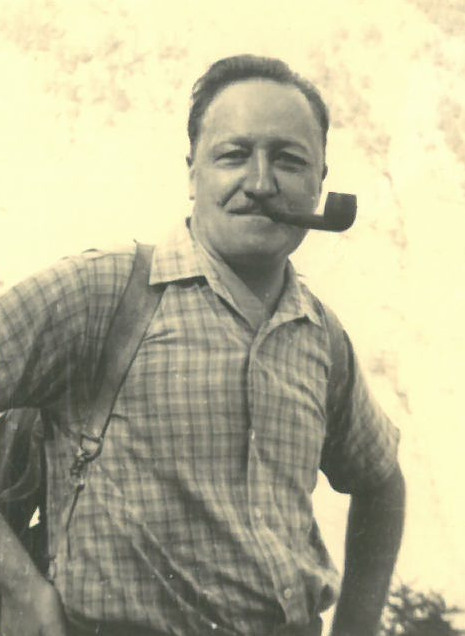
A portrait of Carlo Enrico Malan. - Arch. famiglia Malan
You might also be interested in...
- book L'erbario Malan
- emoji_nature Beech
- tactic Herb-to-change
- campaign Monitoraggio ittico del Lago Nero
- campaign "What a bunch of flowers" and the protection of wild flora
- campaign Accidental Poisoning by Toxic Plants in Pets: A Project to Diagnose and Manage Them
- campaign Poisonous plant species and grazing animals
- campaign Un articolo scientifico per il cortippo di greto
- campaign Biodiversity at risk: the Emys orbicularis
- campaign Two days of discussion on water resource management